Charles Oliveira stuns Max Holloway at UFC 326

LAS VEGAS -- 36-year-old Charles Oliveira turned back the clock and shocked the world at UFC 326 on Saturday, putting on a dominant performance against heavily favored Max Holloway to win the BMF belt by unanimous decision, 50-45, at T-Mobile Arena.

Field Level Media

Oliveira stunned Holloway in the early stages of the first round of their lightweight bout and controlled the fight from that point forward, logging a remarkable 20:49 of control time while succeeding on 5-of-13 takedown attempts. Oliveira's insistence at keeping the fight on the ground drew some boos from fans who were hoping for a typical BMF-style brawl, but the Brazilian jiu-jitsu artist also landed his strikes at a higher percentage and volume than Holloway in addition to his elite ground performance.

The win was a full circle moment for Oliveira, who lost to Holloway in 2015 after suffering a shoulder and esophagus injury on a first-round takedown attempt rendered him unable to compete. Oliveira is now the fourth BMF champion in UFC history, joining Holloway, Justin Gaethje and Jorge Masvidal.

The co-main event saw "Fighting Nerds" founder Caio Borralho defeat Reiner De Ridder in a unanimous 30-27 decision, although the fight was certainly more competitive than the final scorecards indicated. Regardless, Borralho rebounded from his disappointing loss to Nassourdine Imavov in September and now has his sights set on former middleweight champion Dricus Du Plessis, whom Borralho called out in his post-fight interview.

Advertisement

The second bout of the main card between Drew Dober and Michael Johnson drew some unwanted attention on betting markets in the hours leading up to the fight, after a series of posts on social media led to a drastic line shift that saw Johnson move from a -155 favorite last week to a +150 favorite in the hours leading up to the fight. Johnson, whose last scheduled fight against Alexander Hernandez at UFC 324 was pulled due to betting irregularities, was knocked out with a thundering left hook from Dober at 1:53 in the second round.

Fighting for the first time on the main card of a numbered UFC event, rising 21-year-old Raul Rosas Jr. earned his fifth straight win and third straight unanimous decision with a clinical wrestling performance against 13th-ranked bantamweight Rob Font. Rosas Jr. registered over 10 minutes of control time and landed 16-of-18 takedown attempts, putting together the most dominant performance of his young career to this point.

The main card started off with a bang thanks to Gregory "Robocop" Rodrigues, who avenged his first-round knockout loss to Brunno Ferreira at UFC 283 with a first-round knockout of his own on just his second strike attempt, 1:47 into Saturday's fight. Since that initial loss to Ferreira in 2023, Rodrigues has won six of his last seven fights, including four by KO/TKO.

--Will Despart, Field Level Media

Charles Oliveira stuns Max Holloway at UFC 326

LAS VEGAS -- 36-year-old Charles Oliveira turned back the clock and shocked the world at UFC 326 on Saturday, putting ...
When the Lionel Messi circus comes to town, MLS teams need a bigger tent

BALTIMORE — Messi League Soccer — or Major League Soccer, as it shall again be known when the Argentine maestro heads home someday — barnstormed into a new big top Saturday.

Yahoo Sports

Inter Miami is Cirque de Soleil with a supernatural ringmaster sent to charm audiences outside the regular tour stops with unrivaled performance art.

Lionel Messi is MLS' — and the sport's — greatest attraction, and so this offseason it was off to Peru, Colombia and Ecuador for friendlies and, two weeks ago, a one-night stint inPuerto Rico marred by an invading fan and a security officer knocking down the superstar.

The season opener at Los Angeles FC was relocated from tidy BMO Stadium across the park to the vast Coliseum.

For a nervy 2-1 victory Saturday, Inter Miami hit Inner Harbor to play D.C. United, which sacrificed home-pitch advantage for an NFL stadium 37 miles north to sell 3 1/2 times more tickets than it would have at Audi Field.

Thousands of Messi gawkers among the announced sellout of 72,026 at M&T Bank Stadium — there were a few thousand empty seats — helped offset United's 2025 attendance plunge and underwhelming turnout for the 2026 home opener two weeks ago.

Moving to a larger location was good business — no argument there — but it also gave off carnival vibes. Three decades since its launch, MLS remains a thirsty operation reliant on Messi and other big names late in their careers for attention outside the league bubble. From a competitive standpoint, United wasn't doing its team any favors; it was all about revenue and marketing.

Miami welcomed the pink-clad support.

"It's definitely nice to be able to go to away stadiums and know you probably have more supporters than the actual home team sometimes," goalkeeper Dayne St. Clair said. "Obviously that won't be the case in every single stadium, but I think it was definitely the case tonight."
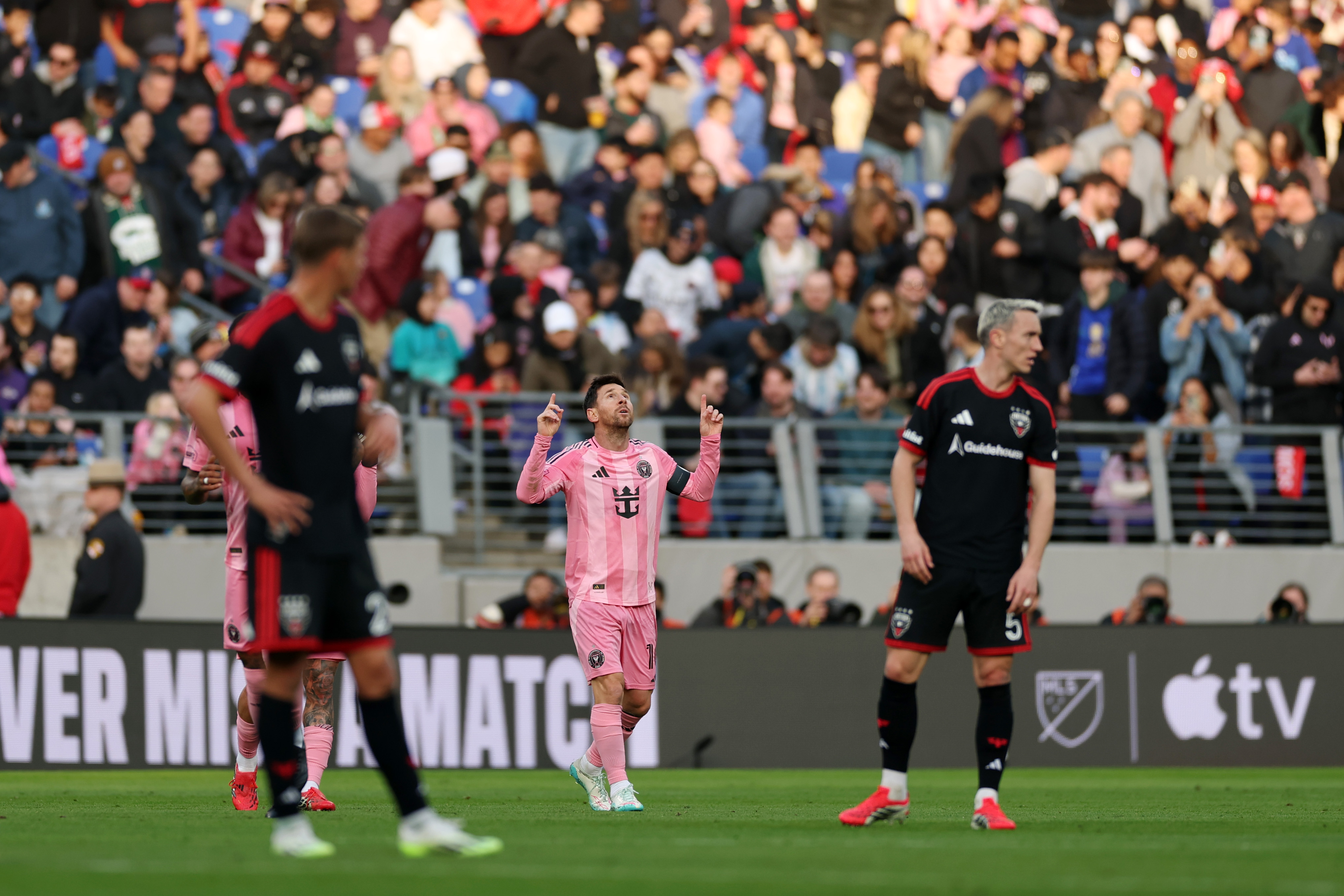
BALTIMORE, MARYLAND - MARCH 07: Lionel Messi #10 of Inter Miami CF celebrates after scoring the team's second goal during the MLS match between D.C. United and Inter Miami CF at M&T Bank Stadium on March 07, 2026 in Baltimore, Maryland. (Photo by Patrick Smith/Getty Images)

At the center of it was Messi, who goes where he is told, probably without the slightest idea where Baltimore is or why he's there.

He did know where he was Thursday:at the White House, at a time of war, shaking hands with the FIFA Peace Prize recipient, President Donald Trump, at a ceremony honoring the reigning MLS Cup champions.

By all accounts, Messi is not a political person, but he has stepped into sticky situations before as a well-paid Saudi tourism ambassador. The White House invitation was extended to Inter Miami, not Messi himself, but given Messi's outsized influence at the club and in the league, he and his handlers could've quietly discouraged it.

Messi is so popular and his brand so secure, though, the potential damage of appearing with a polarizing political figure probably won't amount to much before his expected World Cup farewell this summer across North America.

The White House visit wasn't without awkwardness. As Trump spoke about the bombing of Iran, Messi, standing to the president's right, shifted his weight back and forth, looked down and coughed nervously into his left hand.

Trump's comments about soccer brought a smile to Messi's face; he doesn't speak English but clearly understands some. Later, he presented Trump with a commemorative pink ball.
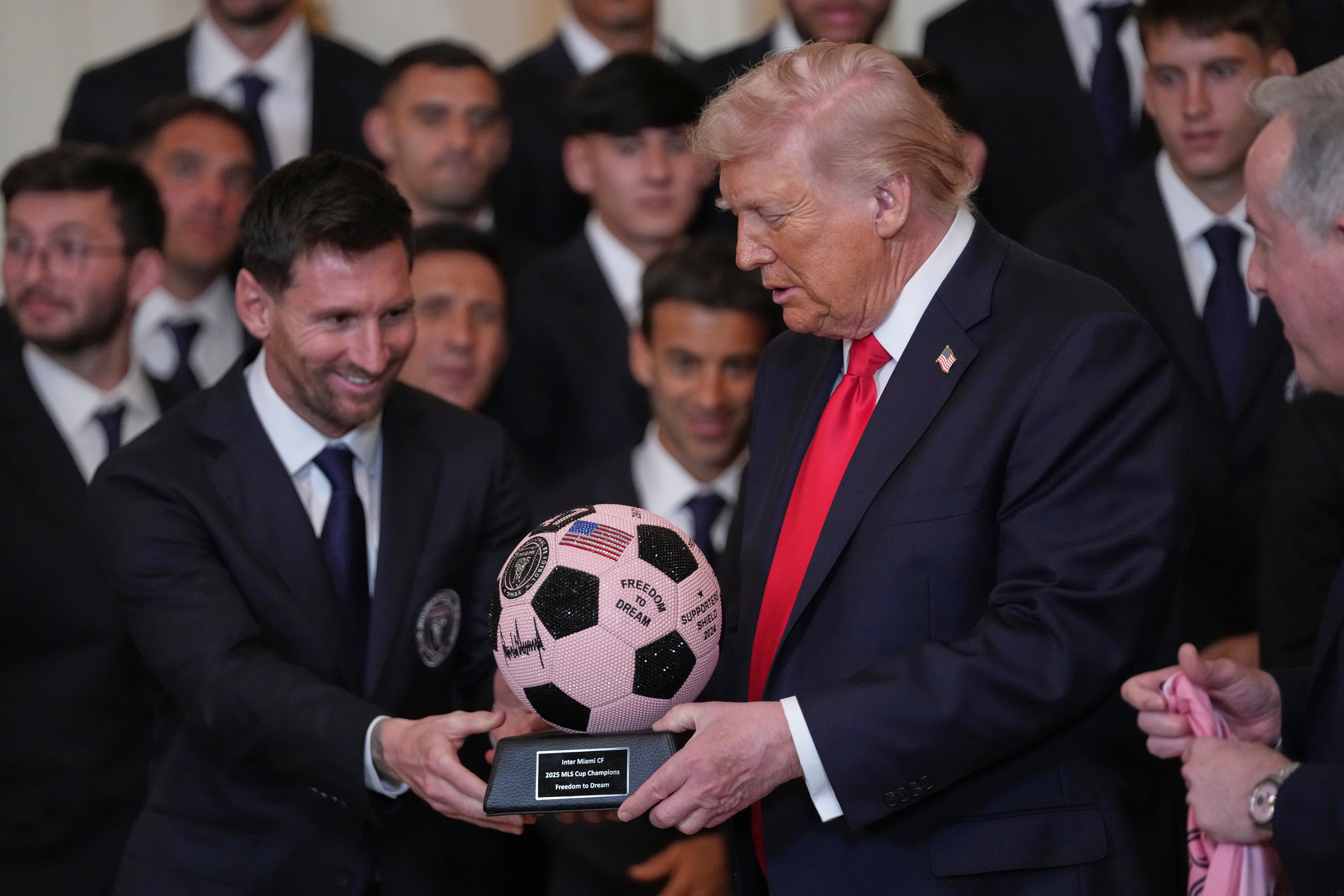
President Donald Trump receives a soccer ball trophy from Lionel Messi during an event to honor the 2025 Major League Soccer champions Inter Miami in the East Room of the White House, Thursday, March 5, 2026, in Washington. (AP Photo/Julia Demaree Nikhinson)

Asked in his video call with reporters Friday about the White House visit, coach Javier Mascherano said in Spanish, "I thought we were going to talk about soccer." He then explained the visit had been in place for a few months and followed protocol for a championship team.

St. Clair said Trump's political rhetoric in front of the team was "definitely a little bit awkward … and kind of threw a lot of guys off, because it was supposed to be about the team and winning last year. … It's something that's out of our control, and we didn't know that was going to be a part of it as well."

Last year, citing a scheduling conflict, Messi declined then-president Joe Biden's invitation to the White House to receive the Presidential Medal of Freedom.

D.C. United is not the first team to try maximizing the Messi spectacle, though other efforts have come with controversy. Last year, the Columbus Crew angered many loyal supporters by moving its home match against Miami 150 miles north to Cleveland's NFL stadium, where 60,614 tripled normal attendance. (The Haslem family owns both the Crew and Browns.)

"It was nice to have a game in front of so many spectators and in this beautiful stadium," D.C. coach René Weiler said Saturday. "We prefer to have a good result at the end, but it was a nice atmosphere."

Advertisement

Two years ago, Miami's away match against Kansas City took place at Arrowhead Stadium (72,610), quadrupling Sporting Park's 18,457 capacity.

[Join or create a Yahoo Fantasy Baseball league for the 2026 MLB season]

Messi promotions have also backfired. Last year, MLS and the Whitecaps faced a class-action lawsuit after pumping up an appearance that never came to fruition. Fans received steep discounts for food and drinks, and last week the British Columbia Supreme Court approved a $329,000 settlement.

Two years ago, when Messi injured an ankle six weeks before a scheduled appearance at Soldier Field, the Chicago Fire scrambled by offering free tickets to a future game that season and discounted seats the following year, if he didn't play. (He didn't play.)

D.C. fans have never seen Messi at Audi Field. His 2023 MLS debut fell just after Miami's lone visit to Washington, and he was injured in subsequent years. In assembling this year's schedule, United not only passed over its own 20,000-capacity venue in the city, but Northwest Stadium, the unappealing home to the NFL's Washington Commanders, located a few miles east of the city.

The crowd of 75,673 at the Coliseum on Feb. 21 was the second largest for a standalone match in league history, behind the LAFC-L.A. Galaxy derby at the Rose Bowl (82,110) in 2023. Most fans this year supported the home team, not Miami.

Next month, Miami's match in Denver will take place at the NFL venue instead of the small MLS park.

In Baltimore, ticket prices were considerably higher than for a common match at Audi Field, and the cheapest seats on the resale market still available before kickoff started at $78.65 for the corner of the upper deck.

The crowd was a blend of those wanting to see Messi and Miami, those supporting D.C., and those interested in attending a big event. On a backdrop of the Ravens' purple seats, United's black and red mixed with Miami's pink.

The visiting team has been neither fazed nor emboldened by the larger-than-normal crowds.

"The people outside, they can make some noise," Mascherano said, "but they don't play."

Given the proximity to Washington, United should have enjoyed more support. But after years of D.C. ownership neglect and bad-to-bland performances, the stadium looked and sounded like a neutral venue.

Miami went ahead in the 17th minute, courtesy of a D.C. blunder. Lucas Bartlett coughed up possession at the end line to Germán Berterame, who supplied Telasco Segovia, who found Rodrigo De Paul for a neat, 12-yarder.

"It was a gift, the first goal," Weiler said. "That was not expected, but maybe [D.C. was] a little bit nervous because of the atmosphere, the spectators in the stadium and, of course, the opponent."

Ten minutes later, Messi timed his run behind Bartlett to latch onto Mateo Silvetti's lovely ball and one-time an 8-yarder past helpless goalkeeper Sean Johnson.

Aside from an overhead kick by D.C.'s Louis Munteanu that missed by a whisker, the second half trudged along without superlatives or suspense until the 75th minute.

Miami's sloppiness gifted a counterattack to United. St. Clair's diving save thwarted Jackson Hopkins, but Tai Baribo cleaned up the rebound.

United hummed with confidence, while Miami's suspect defense found itself under duress. Given the gap between the clubs, it was an unexpected development, indeed.

"The feeling of not controlling the game is unusual for us because we usually do," Mascherano said. "When we don't, you can see we're displeased."

De Paul squandered a golden opportunity to seal the outcome. Messi kept going until the final whistle. The star-struck portion of the audience seemed satisfied.

Miami's — and Messi's — work was done here, albeit with some discomfort. The show goes on.

When the Lionel Messi circus comes to town, MLS teams need a bigger tent

BALTIMORE — Messi League Soccer — or Major League Soccer, as it shall again be known when the Argentine maestro heads hom...
Khalil Mack, Chargers agree to new contract before NFL free agency

Return of the(Khalil) Mack.

USA TODAY Sports

Khalil Mack has agreed to a new contract with theLos Angeles Chargersto avoid free agency, according to multiple reports. He will sign a one-year deal worth $18 million that is fully guaranteed, as first reported byESPN's Jeremy Fowler.

The 35-year-old Mack was considered the 21st-best player in free agency this year, according toUSA TODAY Sports' Nate Davis. He ranked as the fourth-best outside linebacker and defensive end on the board, with teammateOdafe Owehalso on the list as a pending free agent.

Mack played the 2025 season with theChargers on a one-year deal worth $18 million. He appeared in only 12 games for L.A., thanks to a dislocated elbow that kept him out four games. Regardless, the pass-rusher still recorded 5.5 sacks and 11 quarterback hits to go along with 32 total tackles.

He is no longer at the height of his powers, but Mack can still strike fear into opposing quarterbacks. The Chargers' investment signals that they also agree.

Advertisement

Here's a look at the contract details for Mack.

<p style=OT Tytus Howard: Traded to Cleveland Browns (previous team: Houston Texans)

" style="max-width:100%; height:auto; border-radius:6px; margin:10px 0;" loading="lazy" /> <p style=CB Trent McDuffie: Traded to Los Angeles Rams (previous team: Kansas City Chiefs)

" style="max-width:100%; height:auto; border-radius:6px; margin:10px 0;" loading="lazy" /> <p style=RB David Montgomery: Traded to Houston Texans (previous team: Detroit Lions)

" style="max-width:100%; height:auto; border-radius:6px; margin:10px 0;" loading="lazy" /> <p style=WR DJ Moore: Traded to Buffalo Bills (previous team: Chicago Bears)

" style="max-width:100%; height:auto; border-radius:6px; margin:10px 0;" loading="lazy" />

2026 NFL offseason tracker: Player signings, trades

OT Tytus Howard:Traded to Cleveland Browns(previous team: Houston Texans)

Khalil Mack contract details

Mack inked a one-year, $18 million deal. Here's a look at the full terms, per multiple reports:

  • Term: 1 year

  • Total contract value: $18 million

  • Guaranteed money: $18 million

While the number jumps off the screen, Mack is only the 19th highest-paid at the position in terms of average annual value (AAV), according toOverTheCap.

The positional value has exploded in recent years as the likes ofMicah Parsons,Myles Garrettand others have pushed the market into the $40 million range.

This article originally appeared on USA TODAY:Khalil Mack contract details: Chargers ink one-year deal with LB

Khalil Mack, Chargers agree to new contract before NFL free agency

Return of the(Khalil) Mack. Khalil Mack has agreed to a new contract with theLos Angeles Chargersto ...
Oil built the Persian Gulf. Desalinated water keeps it alive. War could threaten both

Asmissiles and dronescurtail energy production across the Persian Gulf, analysts warn that water, not oil, may be the resource most at risk in the energy-rich but arid region.

Associated Press An incoming projectile explodes over the water as Israel issues a nationwide alert following its strikes on Iran, in Haifa Bay, northern Israel, Saturday, Feb. 28, 2026. (AP Photo/Leo Correa) FILE - This image provided by Planet Labs PBC shows the Jebel Ali Port in Dubai, United Arab Emirates, March 1, 2026. (Planet Labs PBC via AP, File) FILE - Fire and a plume of smoke is visible after, according to authorities, debris of an Iranian intercepted drone hit the Fujairah oil facility, in Fujairah, United Arab Emirates, March 3, 2026. (AP Photo/Altaf Qadri) FILE - A pipe carrying drinking water runs through the Carlsbad desalination plant in Carlsbad, Calif., Dec. 2, 2025. (AP Photo/Annika Hammerschlag, File) FILE - A young street vendor carries a pack of water bottles as he looking for customers during a sweltering day on the Mediterranean Sea corniche in Beirut, Lebanon, July 20, 2023. (AP Photo/Hassan Ammar, File)

APTOPIX Israel Iran US

Hundreds of desalination plants sit along the Persian Gulf coast, putting individual systems that supply water to millions within range of Iranian missile or drone strikes. Without them, major cities could not sustain their current populations.

In Kuwait, about 90% of drinking water comes from desalination, along with roughly 86% in Oman and about 70% in Saudi Arabia. The technology removes salt from seawater — most commonly by pushing it through ultra-fine membranes in a process known asreverse osmosis— to produce the freshwater that sustains cities, hotels, industry and some agriculture across one of the world's driest regions.

For people living outside the Middle East, the main concern of the Iran war has been theimpact on energy prices. The Gulf produces about a third of the world's crude exports and energy revenues underpin national economies. Fighting has already halted tanker traffic through key shipping routes and disrupted port activity, forcing some producers to curb exports as storage tanks fill.

But the infrastructure that keeps Gulf cities supplied with drinking water may be equally vulnerable.

"Everyone thinks of Saudi Arabia and their neighbors as petrostates. But I call them saltwater kingdoms. They're manmade fossil-fueled water superpowers," said Michael Christopher Low, director of the Middle East Center at the University of Utah. "It's both a monumental achievement of the 20th century and a certain kind of vulnerability."

Early signs of risk

The war that began Feb. 28 with U.S. and Israeli attacks on Iran has already brought fighting close to key desalination infrastructure. On March 2, Iranian strikes on Dubai's Jebel Ali port landed some 12 miles from one of the world's largest desalination plants, which produces much of the city's drinking water.

Damage also was reported at the Fujairah F1 power and water complex in the United Arab Emirates, and at Kuwait's Doha West desalination plant. The damage at the two facilities appeared to have resulted from nearby port attacks or debris from intercepted drones, and so far there is little evidence of Iran intentionally targeting water treatment sites, experts said.

Many Gulf desalination plants are physically integrated with power stationsas co‑generation facilities, meaning attacks on electrical infrastructure could also hinder water production. Even where plants are connected to national grids with backup supply routes, disruptions can cascade across interconnected systems, said David Michel, senior fellow for water security at the Center for Strategic and International Studies.

"It's an asymmetrical tactic," he said. "Iran doesn't have the same capacity to strike back at the United States and Israel. But it does have this possibility to impose costs on the Gulf countries to push them to intervene or call for a cessation of hostilities."

Desalination plantshave multiple stages — intake systems, treatment facilities, energy supplies — and damage to any part of that chain can interrupt production, according to Ed Cullinane, Middle East editor at Global Water Intelligence, a publisher serving the water industry.

"None of these assets are any more protected than any of the municipal areas that are currently being hit by ballistic missiles or drones," Cullinane said.

A long-standing concern

Gulf governments and U.S. officials have long recognized the risks these systems pose for regional stability: if major desalination plants were knocked offline, some cities could lose most of their drinking water within days. A 2010 CIA analysis warned attacks on desalination facilities could trigger national crises in several Gulf states, and prolonged outages could last months if critical equipment were destroyed.

More than 90% of the Gulf's desalinated water comes from just 56 plants, the report stated, and "each of these critical plants is extremely vulnerable to sabotage or military action."

A leaked 2008 U.S. diplomatic cable warned the Saudi capital of Riyadh "would have to evacuate within a week" if either the Jubail desalination plant on the Gulf coast or its pipelines or associated power infrastructure were seriously damaged.

Saudi Arabia has since invested in pipeline networks, storage reservoirs and other redundancies designed to cushion short-term disruptions, as has the UAE. But smaller states such as Bahrain,Qatarand Kuwait have fewer backup supplies.

Climate change could threaten water plants

As warming oceans increase the likelihood and intensity of cyclones in the Arabian Sea and raise the chances of landfall on the Arabian Peninsula, storm surge and extreme rainfall could overwhelm drainage systems and damage coastal desalination.

Advertisement

The plants themselves contribute to the problem. Desalination is energy-intensive, with plants worldwide producing between 500 and 850 million tons of carbon emissions annually, approaching the roughly 880 million tons emitted by the entire global aviation industry.

The by-product of desalination, highly concentrated brine, is typically discharged back into the ocean, where it can harm seafloor habitats and coral reefs, while intake systems can trap and kill fish larvae, plankton and other organisms at the base of the marine food web.

As climate change intensifies droughts, disrupts rainfall patterns and fuels wildfires, desalination is expected to expand in many parts of the world.

The threat is not hypothetical

During Iraq's 1990-1991 invasion of Kuwait and the subsequent Gulf War, Iraqi forces sabotaged power stations and desalination facilities as they retreated, said the University of Utah's Low. At the same time, millions of barrels of crude oil were deliberately released into the Persian Gulf, creating one of the largest oil spills in history.

The massive slick threatened to contaminate seawater intake pipes used by desalination plants across the region. Workers rushed to deploy protective booms around the intake valves of major facilities.

The destruction left Kuwait largely without fresh water and dependent on emergency water imports. Full recovery took years.

More recently, Yemen's Houthi rebels have targeted Saudi desalination facilities amid regional tensions.

The incidents underscore a broader erosion of long-standing norms against attacking civilian infrastructure, Michel said, noting conflicts in Ukraine,Gazaand Iraq.

International humanitarian law, including provisions of the Geneva Conventions, prohibit targeting civilian infrastructure indispensable to the survival of the population, including drinking water facilities.

The potential for harmful cyberattacks on water infrastructure is a growing concern. In 2023 and 2024, U.S. officials blamed Iran-aligned groups for hacking into several American water utilities.

Iran's own water supply at risk

After a fifth year of extreme drought, water levels in Tehran's five reservoirs plunged to some 10% of their capacity, prompting President Masoud Pezeshkian to warn the capital may have to be evacuated.

Unlike many Gulf states that rely heavily on desalination, Iran still gets most of its water from rivers, reservoirs and depleted underground aquifers. The country operates a relatively small number of desalination plants, supplying only a fraction of national demand.

Iran is racing to expand desalination along its southern coast and pump some of the water inland, but infrastructure constraints, energy costs and international sanctions have sharply limited scalability.

"They were already thinking of evacuating the capital last summer," Cullinane of Global Water Intelligence said. "I don't dare to wonder what it's going to be like this summer under sustained fire, with an ongoing economic catastrophe and a serious water crisis."

Follow Annika Hammerschlag on Instagram@ahammergram.

The Associated Press receives support from the Walton Family Foundation for coverage of water and environmental policy. The AP is solely responsible for all content. For all of AP's environmental coverage, visithttps://apnews.com/hub/climate-and-environment

Oil built the Persian Gulf. Desalinated water keeps it alive. War could threaten both

Asmissiles and dronescurtail energy production across the Persian Gulf, analysts warn that water, not oil, may be the res...
Decades after violence in Selma spurred the Voting Rights Act, organizers worry about its fate

SELMA, Ala. (AP) — Sixty-one years after state troopers attacked Civil Rights marchers on the Edmund Pettus Bridge in Selma, thousands are gathering in the Alabama city this weekend, amid new concerns about the future ofthe Voting Rights Act.

Associated Press FILE - State troopers hit protesters with billy clubs to break up a civil rights voting march in Selma, Ala., on Sunday, March 7, 1965. (AP Photo/File) FILE - Tear gas fills the air as state troopers, ordered by Gov. George Wallace, break up a march at the Edmund Pettus Bridge in Selma, Ala., on Sunday, March 7, 1965. (AP Photo/File)

Bloody Sunday Anniversary

The March 7, 1965, violence that became known asBloody Sundayshocked the nation and helped spur passage of the landmark legislation that dismantled barriers to voting for Black Americans in the Jim Crow South.

But this year's anniversary celebrations — events run all weekend and end with a commemorative march across the bridge Sunday — come asthe U.S. Supreme Court considers a casethat could limit a provision of theVoting Rights Actthat has helped ensure some congressional and local districts are drawn so minority voters have a chance to elect their candidate of choice.

"I'm concerned that all of the advances that we made for the last 61 years are going to be eradicated," said Charles Mauldin, 78, one of the marchers who was beaten that day.

Justices are expected to rule soon on a Louisiana case regarding the role of race in drawing congressional districts. A ruling prohibiting or limiting that role could have sweeping consequences, potentially opening the door for Republican-controlled states to redistrict and roll back majority Black and Latino districts that tend to favor Democrats.

Democratic officeholders, civil rights leaders and others have descended on the southern city to pay homage to the pivotal moment of the Civil Rights Movement and to issue calls to action. Likethe marchers on Bloody Sunday, they must keep pressing forward, organizers said.

Advertisement

Former state Sen. Hank Sanders, who helped start the annual commemoration, said the 1965 events in Selma marked a turning point in the nation and helped push the United States closer to becoming a true democracy.

"The feeling is a profound fear that we will be taken back — a greater fear than at any time since 1965," Sanders said.

U.S. Rep. Shomari Figures won election in 2024 to an Alabama district that was redrawn by the federal court. He said what happened in Selma and the subsequent passage of the Voting Rights Act "was monumental in shaping what America looks like and how America is represented in Congress."

"I think coming to Selma is a refreshing reminder every single year that the progress that we got from the Civil Rights Movement is not perpetual. It's been under consistent attacks almost since we've gotten those rights," Figures said.

In 1965, the Bloody Sunday marchers led by John Lewis and Hosea Williams walked in pairs across the Selma bridge headed toward Montgomery. Mauldin, then 17, was part of the third pair behind Williams and Lewis.

At the apex of the bridge, they could see the sea of law enforcement officers, including some on horseback, waiting for them. But they kept going. "Being fearful was not an option. And it wasn't that we didn't have fear, it's that we chose courage over fear," Mauldin recalled in a telephone interview.

"We were all hit. We were trampled. We were tear-gassed. And we were brutalized by the state of Alabama," Mauldin said.

Decades after violence in Selma spurred the Voting Rights Act, organizers worry about its fate

SELMA, Ala. (AP) — Sixty-one years after state troopers attacked Civil Rights marchers on the Edmund Pettus Bridge in Sel...


INS MAG © 2015 | Distributed By My Blogger Themes | Designed By Templateism.com